If you’ve just accepted a speaking engagement, maybe at a conference, remember that your avowed intention is to bore everybody. This is really quite simple if you follow a few rules.
Written by Roger HB Davies, Co-CEO
-
Put little thought into your presentation.
Indeed, slap it together last-minute just before you are due to speak. This way no one can provide feedback prior to its delivery. You will thus be able to surprise everyone with your original thoughts. Of course, by planning your thoughts last-minute will likely ensure no structure, and minimal logic to the presentation of your ideas, thereby ensuring audience confusion.
-
Deliver your words in a droning monotone, the key to any boring speech.
This takes very little practice. Lack of facial expression helps. Don’t smile. Don’t move your hands.
-
Support your words with irrelevant visuals of questionable quality and quantity.
Using slides has its advantages. Bear in mind that PowerPoint is the world’s most widely used eye-sight test. So use varying font sizes, ideally below 6 point. This way you can present complicated tables/charts/numbers with no chance of anyone reading them unless they possess opera glasses.
This has a further advantage in that you won’t receive any awkward questions. If the audience doesn’t know what they’re looking at they are less likely to challenge you.
Also, having the lights out to show the slides will mean that you have a captive audience since delegates can’t leave without falling over themselves.
If you have taken any photos, select the ones that are blurred and out of focus. This also discourages questions because delegates can’t see quite what’s projected.
-
Avoid all efforts to use humour.
If by accident someone does laugh at something you said, make sure your next comments are drowned out by the audience laughter.
-
Before starting, and at the last-minute, enthusiastically tap the microphone.
This gives people the impression that you’re testing the sound system. With a bit of luck you will short-circuit the whole system and give the AV staff something to do.
-
When speaking make sure that your hands cover your face as often as possible.
This interferes with your diction. It also has the added benefit of disguising your real identity, very useful in the unlikely event of someone tracking you down to ask you questions afterwards.
-
Distract your audience.
During your delivery make sure you do as many distracting things as possible. If you feel like scratching, scratch. If you feel like sneezing, sneeze. Rattle your jewelry, car keys, loose coins. But don’t wave your arms around too much since it will appear that you are emphasizing key points – which you certainly don’t want to do.
-
Turn up late for your slot on the podium; then talk beyond your allotted time.
This reinforces the boredom and further guarantees less questions at the end.
-
Use long words where possible.
Your use of language is extremely important. Avoid colorful phrases. Keep your sentences long, complex. Throw in a cliché or two. Mix your metaphors.
-
Use such filler words as: um, ah, and “like”.
You get the gist, um, ah…
If someone is awake after all of this, and then so boldly asks a question, ensure your reply is completely unintelligible. Remember the adage “if in doubt, mumble.”
Don’t forget that gaining a reputation as a boring speaker has its advantages. There is the obvious carryover to your organization that must be a serious player since it hired you.
With not too much thought or effort, you will quickly become an adept proponent of boring speech. No longer will public speaking be an ordeal. As your reputation gains momentum, you will confidently mount the podium knowing full well that no one will be listening. And then it won’t matter what you say.
—
If You Don’t Want To Be A Boring Speaker
Now is the time to build your reputation as an impactful and engaging speaker.
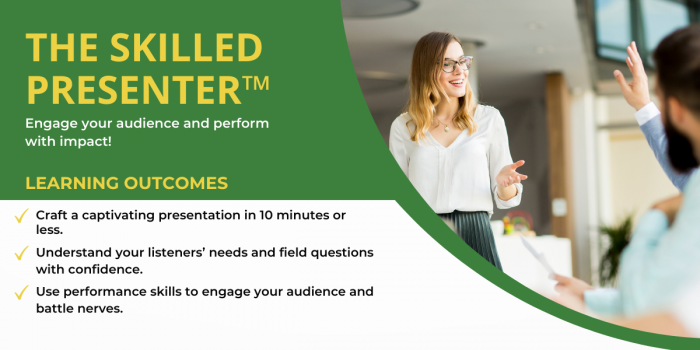
Consider attending our workshop The Skilled Presenter™. We regularly hold public and in-house workshops in Canada (Toronto), England (London), and Australia (Melbourne) focused on developing these skills. Learn more by clicking below.